The grey wolf - otherwise known as the timber wolf, white wolf or 'common' wolf - lives in a variety of habitats, from the Arctic tundra and open steppes of Russia, to the mountainous regions and forests of the northern hemisphere. It has a highly organised social structure which enables it to enjoy the maximum cooperation when hunting, communicating, and defending its territory. So successful was it that the grey wolf was once the world's most widespread mammal.
However, the grey wolf has always been feared by man and has been persecuted more than any other animal, but its cunning, intelligence, and flexibility have saved it from extinction.
Once widespread throughout North America, Canada, Europe and the Far East, the grey wolf is sadly now only found in large numbers in specific parts of Russia, North America and Eastern Europe. Small numbers also occur in the Abruzzi mountains in Italy.
The main reason for the wolf's continuing decline has been the dramatic reduction of its natural prey. This has largely been replaced by farm stock which is protected by the use of poisons, traps and even guns. It is still shot in Europe despite legal protection.
The final fate of the wolf will depend on whether mankind can allow the animal the co-exist alongside him.
The grey wolf lives in packs of between five and ten animals. Each pack contains a family unit,consisting of a dominant male and female, and the offspring from several years.
The hierarchy that exists within each pack is maintained by dominant or submissive body posturing, as well as other behavioural patterns such as the communal care of the young.
The size of the pack's territory depends on the availability of prey, but usually covers several hundred square kilometres. The grey wolf is fiercely territorial. It scent marks boundaries and makes its presence known by howling to other members of the pack. Calls may be answered by rival wolf packs.
The grey wolf lives in a variety of habitats, from the Arctic tundra and open steppes of Russia, to the mountainous regions and forests of the northern hemisphere. It has a highly organised social structure which enables it to enjoy the maximum cooperation when hunting, communicating, and defending its territory.
The grey wolf lives in packs of between five and ten animals. Each pack contains a family unit,consisting of a dominant male and female, and the offspring from several years. The hierarchy that exists within each pack is maintained by dominant or submissive body posturing, as well as other behavioural patterns such as the communal care of the young.
The size of the pack's territory depends on the availability of prey, but usually covers several hundred square kilometres.
The grey wolf is fiercely territorial. It scent marks boundaries and makes its presence known by howling to other members of the pack. Calls may be answered by rival wolf packs.
What do wolves eat?
The grey wolf is a big-game hunter from the dog family, hunting mostly hoofed animals. A single wolf is capable of catching and killing a deer unaided, but when hunting as a pack, it will prey on larger animals such as the moose.
Relying chiefly on its hearing and sense of smell to detect prey, the wolf will follow its target all day and night if necessary. It is not particularly fast - the wolf has a top speed of about 45 km per hour, but it does have remarkable powers of endurance which is the key to its hunting success. After a kill, each wolf - starting with high ranking individuals - will eat as much meat as it can. This can sometime be as much as one fifth of its entire body weight! What cannot be consumed is left for scavengers, even though the wolf may have to wait another three or four days before it catches its next meal.
Each member of the pack hunts, except for those too young to join in. These remain at home and wait for food to be brought to them.
The Snowy Owl is arguably the most iconic of all the owls, and why wouldn't it be. Pristine white plumage and beautifully dark, soulful eyes, no wonder it is the marketeers number one bird for portraying the spirit of Christmas. Ever since its big-screen début in the Harry Potter franchise the mysticism behind the Snowy owl has grown, but let us not forget that this creature is both a genuine force of nature, and a formidable hunter!
The snowy owl is one of the world’s largest and most powerful owls. It is also the largest bird that inhabits the Arctic region - breeding beyond the tree line on the frozen, barren tundra. It favours areas with rocks or grassy hummocks which the snowy owl uses as lookout posts for spotting prey and predators alike.
The male snowy owl is almost entirely white, with just a few dark flecks on his plumage. The female is more heavily marked, with dark bars on her upper parts, breast and belly. She is also up to one fifth larger, one third heavier and longer claws that the male. This marked difference between the sexes is unique among owls.
What does the snowy owl eat?
In the arctic, the snowy owl feeds mainly on lemming and – to a lesser extent – vole. Elsewhere the snowy owl will eat rabbit, hare and certain birds such as ptarmigan, auk and gull.
Unlike the great majority of owls, the snowy owl rarely hunts during the hours of darkness. Instead, it seeks its prey during the daytime – especially in the twilight of early morning and evening.
After watching from a high perch, the snowy owl glides or hovers over the ground before swooping on to its prey, making the kill with its powerful talons armed with razor-sharp claws.
In the brief Arctic summer, the snowy owl is faced with almost continuous daylight. However, the long Arctic winter brings many hours of darkness and numbing cold, but the owl’s superbly insulating plumage keeps it warm.
Food is scarce during the harsh winter months of the far north, and the snowy owl is capable of fasting for up to forty days at a time. It relies heavily on the thick deposit of fat under its skin that it lays down earlier on in the year, and saves energy by moving as little as possible.
Migration
The snowy owl is a wanderer, moving south in winter in very harsh weather and when prey is scarce in the far north. At intervals, the lemmings – which form the main prey species – suffer a dramatic and sudden drop in their population, resulting in the snowy owls moving much further south.
For many years the snowy owl has been a visitor – albeit a rare one – to northern Britain as well as other parts of northern Europe, but in 1967 birdwatchers were thrilled to learn that a pair of snowy owls has nested on the island of Fetlar, in the Shetland Islands. Careful protection enabled this pair to breed with great success. Within eight breeding seasons, they hatched a total of 49 eggs of which 23 young survived. Since that time all the birds have left the island.
Breeding
The male snowy owl proclaims ownership of his large breeding territory to both rival and prospective mates by bowing violently with his tail cocked, on an elevated ridge or hummock and uttering a series of hollow, booming hoots. These can be heard up to 10km away in the thin Arctic air.
He may chase after rival males and even grapple with them in mid air. A female snowy owl will also defend territory or a potential mate against the interests of other female snowy owls.
The nest is a hollow in the ground, usually on a ridge or outcrop. Like other owl species, the female snowy owl staggers her egg laying. This ensures that the older, stronger chicks will survive during periods of food shortage, by taking most of the food their parents bring to the nest and even killing and eating their younger and weaker siblings.
A food shortage will also affect the number eggs laid. This may range from ten to twelve eggs during plentiful times, down to three or four, or even none at all when lemmings or other prey are scarce
The owlets are covered first with thin white down, but soon acquire a second coat of sooty black down.
At 43 to 50 days old, the young birds can fly and by 60 days they will be able to hunt for themselves. Unfortunately many chicks fall prey to predators such as skua birds and arctic foxes.
The black rhino is considered to be the most aggressive species of its family and despite its massive bulk can charge at great speed at an unwary observer. However, it rarely presses home such attacks, preferring instead to browse the low trees of its wooded habitat, or simply to doze in the cool shade.
Black Rhino facts
1. A black rhino can charge at 50 km per hour and is completely capable of killing a human being. It can even cause serious damage to a car. 2. Black rhinos can't see too well, so they sometimes charge objects like trees and rocks, mistaking them as threats. However, the black rhino has a keen sense of smell and hearing. Black rhinos use the bigger of the two horns on their noses as weapons in a fight. 3. The horns of a rhino are made of a substance similar to that of human fingernails, sometimes break off, but they are able to grow back.
4. A female black rhino was once seen wallowing with 6 turtles picking out ticks as they climbed out her body. 5. The oxpecker bird travels regularly on the rhino's back, and provides valuable services. Not only do they pick out ticks, they also screech loudly when humans approach. 6. A black rhino calf follows its mother while she clears a path through dense cover, but a young white rhino is more likely to run on ahead. 7. In several Asian cultures, people believe that a rhino horn provides powerful medicine for a variety of ailments. Other people, who live mainly in northern Africa, use rhino horns to make the handles for special daggers. Since rhino horns fetch high prices, many poachers are willing to break the law and kill these endangered animals.
Where does the black rhino live?
The black rhino lives in hilly areas on the edges of woodland. Although the male rhino – known as a bull – is a solitary beast, his home range usually overlaps with those of other bulls.
These neighbouring bulls are likely to all meet up at their shared waterhole. In fact these regular users appear to know and tolerate each other, and their collective group – known as a clan – is led by one overall, dominant bull.
These clan members challenge any unknown rhinos that visit the waterhole. Snorting loudly, the clan rhinos paw the ground and may even charge, but rarely make physical contact. The encounter usually ends with one rhino – usually the intruder - moving away.
The black rhino uses scent as a signal, spraying urine along paths and using communal dung-heaps. It scrapes with its hind feet after defecating in order to collect and carry the scent away with it.
What do rhinos eat?
The black rhino browses on trees and shrubs. Having pulled down branches from shrubs with its lips, it strips the leaves and shoots from these with a specialised upper lip which is prehensile.
The rhino also pulls up small seedling trees, and takes fruit from both trees and wind fall off the ground. It cannot easily graze, but it can tear up and eat clumps of long grasses.
Since the black rhino needs to drink at least once a day, it will stay within 5km of water. In very dry conditions, the black rhino can dig for water using its forefeet.
The rhino will approach a waterhole using regular, heavily trodden paths which are clearly visible in the surrounding undergrowth.
The black rhino feeds at dawn and dusk, spending most of the core day sleeping or in a mud wallow.
Enemies of the rhino
The black rhino has few natural predators. A lion may try and take a calf, and while a pack of spotted hyena is a more serious threat, poaching is the biggest threat to the black rhino’s existence. In fact, it is believed that poaching rhinos for their valuable horns is now responsible for a 80% reduction in rhino numbers since 1970.
Believe it or not, but rhino horn handled knives bought by young men in Yemen accounted for the death of 8000 rhinos between 1969 and 1977.
Rhino horn is also powdered for medicinal purposes by the Chinese.
Rhino breeding
In order to try and attract a female rhino – known as a cow, a bull rhino brushes his horn over the ground, charges at bushes, rushes back and forth and frequently sprays urine.
If the bull is successful, and after a gestation period of approximately 15 months, the female will retreat into dense cover in order to give birth. Although the calf can walk when barely 10 minutes old, it could easily be trampled, so the mother keeps it hidden for the next couple of weeks, defending it fiercely from predators.
The black rhino will stop growing when about 7 years old. The female can breed before this, but in the wild she bears just one calf every two to five years.
One of the strangest-looking of all mammals, the duck-billed platypus is the size of a rabbit and has a unique bird-like bill. It is one of only three mammals in the world to lay eggs.
Although it is not threatened in the wild, modern pressures on its freshwater habitat mean that it may need careful protection in the future
Where does the duck-billed platypus live?
The duck-billed platypus always lives near water, inhabiting the rivers of eastern Australia and Tasmania. It nests in tunnels that it digs out of the river banks, although sometimes it will live in deep crevices and little caves in areas where the river runs between rocky banks. Their tunnels can be in the region of 15 metres long, although they are usually much shorter.
The duck-billed platypus is truly amphibious as it is perfectly at home on both land and water. It lives a solitary life except during the breeding season, and is considered to be quite territorial in its need to secure stretches of the river for feeding rights.
It uses its strong, webbed front feet for both swimming and burrowing. When it walks on land, it curls these feet right under its body in order to protect them.
What does the duck-billed platypus eat?
The duck-billed platypus finds its food in the water, where it hunts for small prey such as insect larvae, water snails and small crustaceans.
Under the water it closes its eyes, ears and nostrils and uses its broad bill to locate prey. The bill is soft and pliable (not hard like a birds) and is highly sensitive. The platypus sweeps it from side to side as it searches along the bottom of the river. It sometimes remains underwater by wedging itself below a log or in a crevice under a stone.
Down on the river bed, the platypus takes food up into its cheeks. When the cheek pouches are full, the platypus comes up to the surface again. There it discards any sand and stones that it has accidentally picked up and grinds the food between the horny plates it has instead of teeth.
It swims along using its front feet only, and most of its dive lasts between half a minute, and a minute and a half. However, if need be, the duck-billed platypus is capable of staying submerged for longer.
Duck-billed platypus breeding
The male and female platypus come together to mate between August and October. The courtship takes place in the river, with the prospective pair swimming around each other.
The female platypus then digs a long nesting tunnel in the river bank with a birthing chamber at its end. The nesting tunnel is longer than the platypus’ home tunnel – it may be as much as 20 metres long!
The female collects grass and leaves and carries them back to the tunnel grasped under her tail. She then constructs a nest within the birthing chamber. There, she will lay two white, soft-shelled eggs which she incubates by holding them snugly between her tail and belly. Each egg is about the size of a large marble.
The hatching period is thought to be variable, but after about 1-2 weeks the eggs will hatch and the young make their way through their mother's fur to a glandular patch where milk is produced.
The youngsters stay within the burrow for 4-5 months, and continue to take their mother milk after they have left the burrow. They are playful, and have been seen to romp around like puppies.
Duck billed platypus facts.
1. The duck-billed platypus has a hollow spur on the back of each of its rear feet. Each spur contains enough poison to kill a dog. The spur may be used in rivalry fights. 2. The platypus is considered to be one of the most primitive of mammals. The only other mammals that lays eggs, like their reptilian ancestors did, are the platypus’ only relative – the two echidnas of Australia and New Guinea. 3. When the first species of this mammal was seen in England in the late 1700’s, it was thought to be a fake. Scientists assumed that a joker had stitched together a duck's beak and a mammal’s body. 4. At around 32 degrees Celsius, the body temperature of the platypus is remarkably low for a mammal. 5. The duck-billed platypus can change its shape very easily. Its body is like a strong tube of muscle and it can easily squeeze through narrow spaces and out of someone’s grip. 6. The word platypus also comes from the Greek for 'flat' and 'foot'. 7. The duck-billed platypus can sense prey by means of electrolocation - this is the ability to detect the
tiny electric impulses given off by animals when they move. Click here for related articles: DUCK-BILLED PLATYPUS - AMAZING FACTS! Nat-Geo Duck-Billed Platypus WHAT IS A DUCK-BILLED PLATYPUS
The subject of many myths and hunters’ tales, the jaguar is the largest wild cat native to the Americas. It is now extremely rare outside captivity as the result of being hunted for its attractive skin.
Jaguars live in a variety of habitats, from dense jungle and scrub land to reed thickets and shoreline forests. They will even live in open country provided the grass and rocks offer sufficient cover for hunting and a reliable supply of water is available.
Where do jaguars live?
Jaguars were once found everywhere from Arizona to Argentina, but ruthless hunting has wiped them out from most of their range, and reduced them greatly elsewhere.
In many countries, rapid expansion of forest clearing to provide pastures for beef cattle and to build new settlements has finished what the hunters began. Jaguars are said to still be common in the upper basin of the Orinoco, Venezuela, but almost everywhere else they are in danger of extinction. In fact there are believed to be less that 200 jaguars left in the whole of Argentina! At this rate, the only flourishing population of jaguars left will be those held by world’s zoos.
Jaguars have a reputation for being man-eaters, and there are many hunters’ tales of men being followed for mile after mile through the forest by a solitary jaguar, which eventually fades away as silently as it appeared. This suggests that the animal was escorting the men off from its territory. If the jaguar had been hunting them, it would have had plenty of opportunities to attack and kill its intended prey.
Adult jaguars are solitary animals, except during the breeding season when a male and female stay together for a short while in order to mate. The young jaguars stay with their mother for the first few years of life before leaving the family to find hunting territories of their own.
The size of the jaguar’s territory depends on the availability of food. Where food is plentiful – as you would expect in an area of undisturbed forest – a jaguar should be able to feed itself from a circular area of about 5 km in diameter. Where food is scarcer – perhaps because the forest has been cleared – a jaguar may need a territory of 500 sq km, 30 times larger!
Jaguar breeding
Very little is known about the family life of wild jaguars. For many years they have been hunted for their fur. In fact, during the 1960’s over 1000 were shot every year in the Brazilian Amazon jungle. Hunters became experts at finding and killing them but paid little attention to their way of life. Now, biologists trying to study jaguars in the wild are handicapped because they have become so rare. Most of their information comes from zoos, where jaguars have been bred successfully.
It appears that male and female and female jaguars meet in the wild only to mate. The male leaves as soon as mating is over, and the female brings up the young on her own. She produces between one and four cubs, which are blind at birth and weigh only 700-900 grams each. All-black jaguars are not uncommon. These cubs would have had a spotted father and a black mother.
Two weeks later, the cubs will open their eyes. During the following weeks they begin to explore the world outside of their mothers den until – at about six months old – they begin to accompany her on hunting trips.
The cubs will live and hunt with their mother for the first two years of their life, before leaving to find a territory of their own in which to hunt. A jaguar is sexually mature at three years old, but males do not breed until a year later.
The koala is an arboreal, herbivorous marsupial and one of the most iconic of all the animals native to Australia.
Known as the Australian teddy bear,
English-speaking settlers from the late 18th century first called the 'Koala' a koala bear due to its similarity in appearance to true bears. Although taxonomically incorrect, the name koala bear is still in use today - but only outside of Australia. Why? Because the 'bear' part of its name is discouraged because of the inaccuracy in the name.
What is a koala?
The fact is that Koalas are not even remotely related to bears. It is a marsupial, or pouched mammal. After giving birth, a female koala carries her baby in her pouch for about six months. When the infant emerges, it rides on its mother's back or clings to her belly, accompanying her everywhere until it is about a year old.
Koalas live in eastern Australia, where the eucalyptus trees they love are most plentiful. In fact, they rarely leave these trees, and their sharp claws and opposable digits easily keep them aloft. Because they get so little energy from their diet of eucalyptus leaves, koalas must limit their energy use so during the day they can sleep up to 18 hours tucked into forks or nooks in the trees.
Breeding
Koala baby
Koalas mate between December and March. A single baby is born 35 days later. Amazingly, it is only 2cm long, blind and hairless. By following a trail of saliva laid down by its mother, it forces its way through its mother's fur to reach the pouch, which - unlike most other marsupials - opens to the rear.
Inside the pouch, the baby koala (known as a joey) attaches itself to a nipple to feed on the mother’s milk. It will continue to grow inside the pouch for approximately 6 months, then during the last month, the mother will begin to feed it with half digested food passed through her rectum. That's right, during weaning the joey eats poo!
At six months the young joey will periodically leave the pouch and move on to its mother’s back where it clings tightly. Three months later, the young koala will be fully grown and able to feed itself. Be that as it may, the young koala will remain with its mother until the next mating season, when it will be driven off by the next male suitor. The young koala will move itself off to another tree and from that point on will live independently until it too becomes sexually mature.
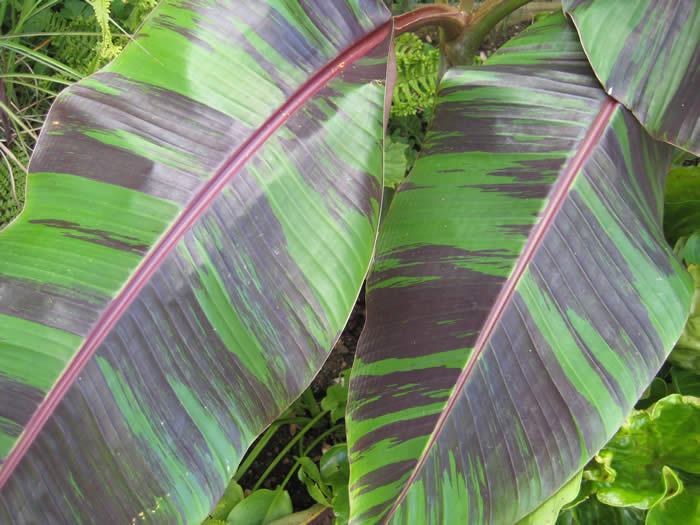
There is nothing even close to a specimen banana plant to bring that exotic, tropical feel to your garden. And now, with ever hardy varieties becoming available, the reality of growing a banana all year round - without cold protection - is becoming more of a reality.
How to grow ornamental bananas
Banana plants
Ornamental bananas are usually best kept within the warm, sunny confines of a south facing conservatory, but there are a couple of examples that could be considered as being 'almost' hardy and well worth the little extra effort involved in growing outside.
The best cultivar for consideration is the hardy Himalayan bamboo 'Musa sikkimensis', but failing that - as availability is sparse - the next best variety would be Musa basjoo. Both of these varieties can even be left outside to over-winter if given suitable protection from hard frosts.
The closely related Ensete ventricosum (sometimes known as Musa ensete) is also worth a try. Even though it is not as hardy, it is far more ornamental by comparison. However, this variety should not be left to overwinter outside - even with adequate protection - unless you live in the mildest of regions. For the stunning red coloured form choose Ensete ventricosum 'Maurelii'.
Banana plants
Position and soil type is what is most important with regards to the successful cultivation of ornamental bananas. You will want to try and position your plant in a sunny site which has a certain amount of protection during the height of summer - not only from the drying effects of the sun, but also to protect the leaves from damage by strong winds. This will also help to maintain humidity levels which are important for healthy growth.
The soil will need to be slightly acidic, and well drained - particularly important for overwintering - with a high organic matter content. Your banana plant will also need plenty of water through the growing season including a regular spraying of the foliage, but refrain from doing this during the hottest part of the day to avoid leaf scorching. Bananas are renown for heavy feeding and so a good tip for successful growth is to add plenty of mulch throughout the growing season. It may also be worth adding a couple of doses of 'sulphate of potash', once at the beginning of the growing season with a second during the height of the summer.
Banana plants
.When the plants are growing strongly, they should be fed with a liquid fertilizer whenever they are watered - except in winter. However, keep an eye on the condition of your plant as regular feeding may cause damage if plants are in poor condition.
Clearly one of the most defining features of the banana tree - apart from its large and distinctive tropical leaves - are its fruit, and although it is possible for this species to bear fruit in this country - given a long and hot summer - try and resist the urge to eat them as they are in fact inedible.
The Wollemi Pine - Wollemia nobilis is one of the world's oldest and rarest plants, and dates back to the time of the dinosaurs. It was discovered, on or about 10 September 1994, by David Noble, a field officer of the Wollemi National Park in Blackheath, in the Blue Mountains.
The Wollemi pine
Noble had good botanical knowledge, and quickly recognised the trees as unusual and worthy of further investigation. Returning with specimens, and expecting someone to be able to identify the plants, Noble soon found that they were new to science and the species was subsequently named after him. However, further study would be needed to establish its relationship to other conifers.
The initial suspicion was that it had certain characteristics of the 200-million-year-old family Araucariaceae. Comparison with living and fossilised Araucariaceae proved that it was a member of that family, and it has been placed into a new genus with Agathis and Araucaria. Fossils resembling Wollemia are widespread in Australia, New Zealand and Antarctica, but Wollemia nobilis is the sole living member of its genus.
The last known fossils of the genus date from approximately 2 million years ago. It is has therefore been described as a living fossil, or alternatively, a Lazarus taxon.
What does the Wollemi pine look like?
The Wollemi Pine - Wollemia nobilis
The Wollemi pine is an evergreen tree reaching 25–40 m (80–130 feet) tall. The bark is very distinctive, dark brown and knobbly, quoted as resembling Coco Pops breakfast cereal.
The tree coppices readily, and most specimens are multi-trunked or appear as clumps of trunks thought to derive from old coppice growth, with some consisting of up to 100 stems of differing sizes.
The branching is unique in that nearly all the side branches never have further branching. After a few years, each branch either terminates in a cone (either male or female) or ceases growth. After this, or when the cone becomes mature, the branch dies. New branches then arise from dormant buds on the main trunk. Rarely, a side branch will turn erect and develop into a secondary trunk, which then bears a new set of side branches.
The Wollemi Pine - Wollemia nobilis
The leaves are flat, linear, 3–8 cm long and 2–5 mm broad. They are arranged spirally on the shoot but twisted at the base to appear in two or four flattened ranks. As the leaves mature, they develop from bright lime-green to a more yellowish-green.
The seed cones are green, 6–12 cm long and 5–10 cm in diameter, and mature about 18–20 months after wind pollination. They disintegrate at maturity to release the seeds which are small and brown, thin and papery with a wing around the edge to aid wind-dispersal. The male (pollen) cones are slender conic, 5–11 cm long and 1–2 cm broad and reddish-brown in colour and are lower on the tree than the seed cones. Wollemi pine seedlings appear to be slow-growing and mature trees are extremely long-lived; some of the older individuals today are estimated to be between 500 and 1000 years old.
With less than 100 adult trees known to exist in the wild, the Wollemi Pine is now the focus of extensive research to safeguard its survival.
The Battle of the Alamo (February 23 – March 6, 1836) was a pivotal event in the Texas Revolution. Following a 13-day siege, Mexican troops under President General Antonio López de Santa Anna launched an assault on the Alamo Mission near San Antonio de Béxar - now modern-day San Antonio, Texas.
President General Antonio López de Santa Anna
All but two of the Texian (a Texian is a anglo-american who emigrated to Texas) defenders were killed. President General Antonio López de Santa Anna's perceived cruelty during the battle inspired many Texians—both Texas settlers and adventurers from the United States—to join the Texian Army . Buoyed by a desire for revenge, the Texians defeated the Mexican Army at the Battle of San Jacinto, on April 21, 1836, ending the revolution.
Several months previously, Texians had driven all Mexican troops out of Mexican Texas. There was approximately 100 Texians garrisoned at the Alamo at this point in time. However, the Texian force grew slightly with the arrival of reinforcements led by eventual Alamo co-commanders James Bowie and William B. Travis.
On February 23, approximately 1,500 Mexican troops marched into San Antonio de Béxar as the first step in a campaign to re-take Texas.
For the next 12 days the two armies engaged in several skirmishes but these had resulted in minimal casualties. Aware that his garrison could not withstand an attack by such a large force, Travis wrote multiple letters pleading for more men and supplies:
Commandancy of the Alamo— Bejar, Fby. 24th 1836— To the People of Texas & all Americans in the world— Fellow citizens & compatriots— I am besieged, by a thousand or more of the Mexicans under Santa Anna—I have sustained a continual Bombardment cannonade for 24 hours have not lost a man — The enemy has demanded a surrender at discretion, otherwise, the garrison are to be put to the sword, if the fort is taken—I have answered the demand with a cannon shot, our flag still waves proudly from the walls — I shall never surrender or retreat Then, I call on you in the name of Liberty, of patriotism everything dear to the American character, to come to our aid,
Unfortunately fewer than 100 reinforcements arrived.
In the early morning hours of March 6, the Mexican Army began their advance on the Alamo. After repulsing two attacks, the Texians were unable to fend off a third attack. As Mexican soldiers scaled the walls, most of the Texian soldiers withdrew into interior buildings. Defenders unable to reach these points were slain by the Mexican cavalry as they attempted to escape.
Between five and seven Texians may have surrendered; if so, they were quickly executed. Most eyewitness accounts reported between 182 and 257 Texians dead, while most historians of the Alamo agree that 400–600 Mexicans were killed or wounded. Several noncombatants were sent to Gonzales to spread word of the Texian defeat. The news sparked a panic, known as "The Runaway Scrape", in which the Texian army, most settlers, and the new Republic of Texas government fled from the advancing Mexican Army.
Within Mexico, the battle has often been overshadowed by events from the Mexican–American War of 1846–48. In 19th-century Texas, the Alamo complex gradually became known as a battle site rather than a former mission. The Texas Legislature purchased the land and buildings in the early part of the 20th century and designated the Alamo chapel as an official Texas State Shrine. The Alamo is now considered to be the most popular tourist site in Texas".
The truth about the Alamo
Films about this famous battle, such as John Wayne’s “The Alamo,” have taught us that Davy Crockett went down fighting and that everybody in the old mission was killed during the 13-day-long siege by the Mexicans. These films also depicted the men as sacrificial lambs who believed that their deaths were inevitable and unavoidable.
In addition, some of these movies have also inferred that the long siege played a key role in the liberation of Texas because it allowed Sam Houston to raise an army that would eventually defeat the Mexicans.
Unfortunately, most of these 'facts' are more myth than reality. For instance, the men defending the Alamo were not nobly suicidal. Though obviously valiant in their stand, they were actually fighting with the belief that reinforcements were on the way to help them defend the old mission.
It also is false that there were no survivals. Although most of the Texians defending the Alamo on March 6, 1836 were killed, approximately 20 people did survive the siege, including women, children and a slave belonging to William B. Travis. In addition, a previously untranslated diary written by Jose Enrique de la Pena, senior Mexican officer at the battle revealed that Crockett and six other survivors had actually surrendered. According to this account, they were were executed afterwards by General Antonio Lopez de Santa Anna, and subsequently were found dead outside of the fort!
As for Sam Houston, he wasn’t rounding up troops, because he was actually serving as a delegate at a constitutional convention at the time the Alamo fell.
In addition, there is one more fact that most of these films have managed to gloss over – the Alamo was not strictly a white Texan or Mexican fight. A third group, the Tejanos, who were Mexicans that lived in Texas, was also fighting alongside Davy Crockett and the others on that March day. So 'Remember the Alamo,' but try to remember the facts about it correctly next time.
The great African Hippopotamus is one of the most iconic of all the African land animals and second in weight only to the elephant.
They are found in western, central, eastern and southern Africa with the highest concentration in the Rift Valley of east and central Africa.
They are ideally adapted to the deep rivers and grassy feeding grounds that form its habitat, spending up to eighteen hours a day in water to keep its body temperature constant and to support its huge frame.
What do hippos do?
The hippo lives in groups of 15 to 20 animals, although these groups can be much bigger under certain circumstances. The hub of the group is a band of females with their young. This nursery group lives on a territory patrolled by a dominant, solitary male – usually at least 20 years old.
Younger males stay in small bachelor groups, and woe betide them is they dare to approach the nursing females. The dominant male uses its greater bulk and long teeth to deter any impudent intruders.
A dominant male is able to defend his territory in this way for up to ten years until finally, a fierce fight with a rival eventually ends his rule. These fights for dominance can even result in death!
Having proved that he is the dominant challenger, the rival then takes his place as the new dominant male in that territory.
Should dominant males meet at the edges of their boundaries, they will turn back to back and defecate, spreading their dung far and wide using their short, flat tails like cricket bats.
Hippo breeding
When a female is ready to mate she will seek out an adult male. About 34 weeks after mating the female leaves the group, and a single calf is born among reeds trampled down by the mother at the edge of the lake. Sometimes the young is born underwater, under these circumstances the baby has to surface quickly in order to draw its first breath.
Within five minutes of giving birth the calf is able to swim and walk. The mother will suckle her young for about 8 months, although the baby will stay with her for several years.
A female is often seen with several young behind her, the youngest will be closest to her while the oldest will be at the end of the line.
Hippopotamus facts
1. Hippos jaws can open to 150 degrees wide. 2. Up to 45% of hippos die in their first year. 3. The term ‘sweating blood’ come from the hippo’s ability to secret a pink fluid from glands beneath the skin. 4. A hippo is not able to survive for long on dry land as it loses water through its skin much faster than other land animals. 5. A hippo can stay underwater for up to 5 minutes and will often walk along the bottom of lakes. 6. Terrapins, birds, and even young crocodiles are often seen to be basking on the backs of hippos. 7. The name 'hippopotamus' comes from the ancient Greek for 'river horse'. 8. The hippo can easily outrun a human, and have been clocked at 30 km/h (19 mph) over short distances. 9. The skin of the hippopotamus is 6 in (15 cm) thick. 10. When in combat, male hippos use their incisors to block each others attacks, and their lower canines to inflict damage. Luckily, hippos rarely kill each other, even in territorial challenges.
Widespread throughout the northern states of North America – including Canada and Alaska, the moose also occurs in Europe and Asia where it is known as the elk. It is the largest of all living deer with the tallest specimens standing as high as 2.3 metres.
The moose is a solitary and unsocial creature. During the spring and summer, males and females remain apart, while the young stay with the females only. During the warmer months of the year, the moose is usually found in low lying areas, often near lakes and marshes.
With the onset of winter, the moose will move onto higher ground to shelter in mixed forests of birch and pine. The harsh conditions can prevent it finding enough to eat, even though the moose will take sustenance from the trees at this time. In areas where there is plenty of food over the winter, moose may form a small group comprising of a male, a few females and their young. The temporary group combine forces to paw at the snow, exposing grasses and twigs to eat.
A weaken moose runs the risk of being attacked by wolves and other predators. While a healthy moose can defend itself, by the end of winter a starving moose is no match for hungry hunters.
Moose Facts
1. During the moose’s breeding season, hunters often imitate the call of a female moose. 2. Julius Caesar how the moose was once widespread in Germany! 3. Male moose have been known to attack railway trains, mistaking the siren for the call of a rival bull 4.A moose can run at speeds of up to 56 km/hour. It is also an excellent swimmer, able to hold it breath underwater for up to a minute and able to sustain a speed of 6 miles per hour (10 km/h).
5. In Siberia, the moose has been domesticated. Not only does it provide meat and milk, it also acts as a ‘work horse’ on farms. 6.The moose has poor vision, but acute senses of smell and hearing. 7. As female moose get older, they are more likely to give birth to twins. 8. The name "moose" comes from the Algonquin Indian term and means "twig eater". 9. Only mature bull moose have antlers, which can be as long as 4 to 5 feet across. 10. It is illegal, and very dangerous, to feed a moose. This is because moose that are used to being fed by humans often become aggressive when they come across a person has no food to offer, and may well attack them. 11. You can identify when a moose might attack if the long hairs on its hump are raised and it's ears laid back. A moose may also lick its lips.
What do moose eat?
Active both day and night, the moose appears to reach its peak of activity at dawn and dusk. The moose is a browsing animal, living off a staple diet of the branches and leaves of willow, birch and aspen.
During the summer, the moose feeds on vegetation growing in and around water, often wading in up to its shoulders when feeding. It will also eat underwater plants, submerging its head to get at the roots and stems.
When the lakes and marshes are frozen over during the winter, the moose will turn its attention to eating berries, twigs and branches. It will also strip the bark from trees and paw through the snow to get at hidden ground vegetation.
Because of its large size, a moose will need to consume nearly 20kg of food every day in order to survive. Unfortunately, due to the harsh conditions in which the moose has evolved to live in, many end up starving in winter.
Breeding
The male and female moose come together to mate during the autumn. This is known as the ‘rut’ and will last only a few weeks. During this time, the male moose – known as a bull – will become very aggressive.
A bull will compete for one female at a time, but he mates with a number in turn. Older males drive younger males away, while serious rivals of equal size fight as a test of strength. Males may sustain bad injuries in these contests, and then can become easy prey to wolves and bears.
The female moose – known as a cow – will give birth to one or two young in the late spring, the bull having long since returned to his solitary existence. She will wean the calves when they are five months old, although they will stay with her until she gives birth again the following year. At this point she may force them to leave her, but they will often rejoin her when she and her new young begin to move again. They eventually disperse to establish ranges of their own.
We are lucky in this country because even though we are an island nation we have in fact 27 different species of native bumble bee to our credit! A fantastic diversity and something we should cherish and be proud of. Unfortunately with the introduction of intensive farming after the Second World War about 95% of natural flower rich pasture land was lost to us as it was turned over to crops. As a result of this, native bumble bee populations are on the decline and two of our native bees species have already become extinct.
What with the problems that honey bees have had to contend with regards to the varroa mite and the still ‘causes unknown’ Colony Collapse Disorder (CCD), the protection of our native bumble bee population has never been more important. What other pollinating insect has the slightest chance of stepping into the honey bees boots should the relentless 30-35% year-on-year loss of honey bee hives continue unabated?
You only need two things to attract native bumble bees into the garden. The first is a reasonable selection of nectar-rich plants that will provide fuel and nutrition throughout their active season. This is important as bumble bees tend to have quite small territories and won’t fly to far from the nests in order to find nectar. The second is a suitable habitat in which to build their nests. Unlike honey bees, most bumble bees live in nests under the ground which are normally only used for that year, but they need a particular type of soil and position.
The nectar that the bumble bees are looking for is the sweet sugary liquid that plants excrete in order to attract pollinators. It is normally found at the base of the flower, and pollinating insects use this nectar for energy.
While they are drinking the nectar the bees are busy scribbling away with their legs, scraping away at the pollen on the anthers. Using specialised ‘comb like’ hairs on their legs they deposit the pollen into basket like structures on their hind legs.
It‘s the pollen that is the major ‘pay off’ here as it is used as a high protein food source for the adult bees and more importantly it is used for feeding (along with honey) to the juvenile larvae.
You can try and create favourable nesting conditions in the garden by providing a free-draining, loose substrate, which is easily dug into by the bees. By creating mounds of soil mixed with about 20% natural sand, and providing a good range of nectar rich plants, you will have a good chance of attracting those queen bees looking for possible nesting sites.
Research has shown that queen bees also prefer some kind of shelter and support structure around the nest, so try positioning your soil sounds around established tree roots or by the base of a sturdy wall. The most important thing for your new bumblebee nest is that it is kept dry at all times. The risk of accidental flooding carries the very real threat of death for both the adult bees and their larvae.
Bumble bees are generally separated into two groups. The first is those bees with short tongues while the second group holds those bees with long tongues. While short tongued bees are more ‘generalist’ feeders and able to make a living off of most flowering plants, the long tongued bees are far more more specialist and it is this group of bees that are predominantly at risk and are currently suffering population declines. However, with front and back gardens accounting for approximately 1 million hectares in this country, even a small change in the type of plants that we grow could have an enormous effect on re-building dwindling bee populations.
To help encourage long tongued bees into the garden, simply providing nectar rich plants isn't the whole answer although it is still a fantastic way to attract other beneficial pollinating insects and butterflies to your garden. You will need to include plants whose flowers have an extended tubular base so that it will accommodate the 'long tongued bees’ long tongue. Plants such as bugles, honeysuckles and quite a few from the lamiaceae family are ideal.